One-sentence journaling: examples for ordinary and difficult days
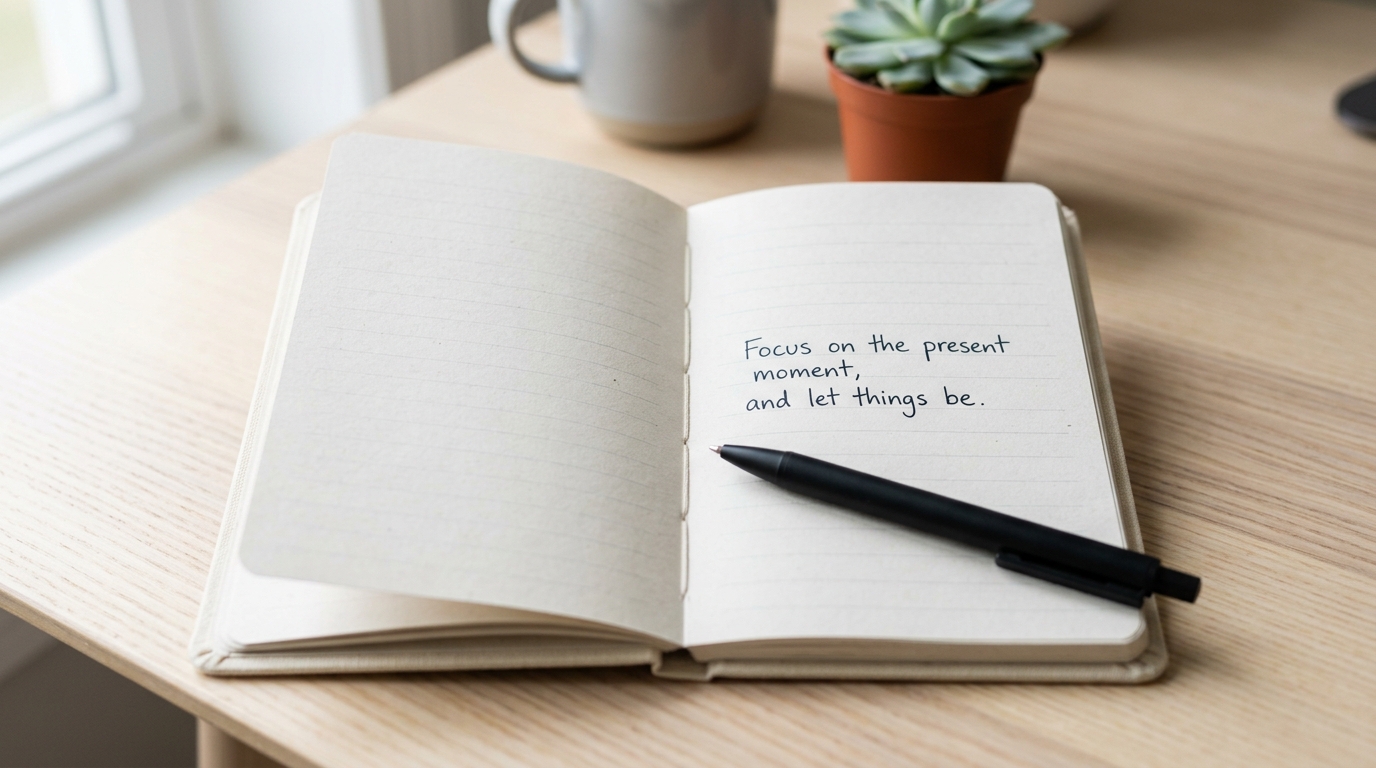
One-sentence journaling means recording a complete entry in a single sentence. That sentence might describe a moment, express something you have not said aloud, or note what you want next. It does not have to summarise the day.
The point of the format is its limit. You can give one detail your attention and then close the journal. On a busy or difficult day, that may be the amount of writing you want to do.
Choose what the sentence is for
A short entry becomes easier when you choose one job for it. Do you want to remember, acknowledge, notice, or ask?
A memory sentence might say, “The street smelled of rain when I walked home carrying dinner.”
An acknowledgment might be, “I was disappointed when the plan changed, even though I said it was fine.”
A noticing sentence could read, “I enjoyed lunch more after I put my phone away.”
A question might be, “Would next weekend feel better with fewer commitments?”
These examples are illustrative, not rules. A fragment is acceptable if a full sentence feels unnatural. You do not need to check grammar, count clauses, or compress five unrelated subjects into one complicated line.
Examples for ordinary days
A day does not need a dramatic event to deserve a record. Small details can be the whole entry.
- “The afternoon was uneventful, and I appreciated that.”
- “I had the same breakfast as yesterday but ate it sitting down.”
- “My neighbour remembered the conversation we started last week.”
- “I spent twenty minutes looking for a receipt that was in my bag.”
- “The first sip of tea was the best part of a very routine morning.”
Choose a detail you actually care about. There is no requirement to turn a missing receipt into a lesson about patience or make breakfast represent a personal transformation.
If you often write “Nothing happened,” try specifying what “nothing” contained. Did you cook, commute, wait, message someone, or watch an episode of something? You can record ordinary life without making it more impressive.
Examples for difficult or uncertain days
You do not owe your journal a reassuring ending. A difficult sentence can remain difficult.
- “I felt left out when the conversation moved on without me.”
- “Today required more patience than I had available.”
- “I do not know what I feel yet, but I know the meeting stayed with me.”
- “I wanted someone to ask a second question after I said I was tired.”
- “I made a mistake, and I am still deciding how to repair it.”
- “I am disappointed that something important to me did not work out.”
Notice the difference between describing an experience and delivering a verdict on yourself. “I forgot the appointment” records what happened. “I ruin everything” expands one event into a judgment about your whole life.
You do not have to replace a painful sentence with praise. You can make it more precise: “I forgot something important, and I feel embarrassed.”
Examples for good days that do not need a scoreboard
Enjoyable moments can be recorded without proving that you were productive, grateful enough, or moving forward.
- “I laughed during the call and kept smiling after it ended.”
- “I felt proud when I explained something clearly.”
- “I liked being included without having to organise everything.”
- “I made a meal I wanted instead of choosing whatever was easiest.”
- “I am glad I went, even though I almost cancelled.”
- “Nothing exceptional happened, but I felt comfortable in my own company.”
You can also keep mixed experiences together: “I enjoyed the celebration and missed the person who could not be there.”
A good entry does not erase the harder parts of your life. It records this particular moment.
Make the practice fit your actual week
Choose a place for the sentences. A single notebook page or ongoing note can be enough. Add the date if you would like to read entries in order later.
An imagined reader, Dev, decides to write after changing out of work clothes. On Monday he records an awkward conversation. On Tuesday he writes about a song on the bus. He misses Wednesday and returns on Thursday.
There is no need to reconstruct Wednesday unless he wants to. The practice remains available without a perfect sequence.
If you want a reminder, attach it to a routine that already happens. If reminders become irritating, remove them. You can keep a journal occasionally and still use the one-sentence format.
For shared devices or spaces, think about where the entry will be visible. Leaving out names can make an entry less identifying, though it does not guarantee privacy.
What if one sentence is not enough?
Let the entry grow if you want. A short format should offer a manageable starting point, not prevent you from saying something important.
You can also keep the sentence and add a small instruction for later: “Return to this when I have more time.” Be selective; every entry does not need a follow-up.
When you reread, look for a detail you want to remember or something you would like to discuss with a person you trust. You do not need to score your mood, count positive days, or extract a pattern from a handful of lines.
For a first attempt, finish this sentence: “The part of today I want to give a little attention to is…”
Write the answer as it comes. If you would like to explore a different setting for reflection, visit MyMindNook and see whether it suits your preferences.
Related journeys
Reflection
How to start journaling when you do not know what to write
A practical starting point for adults facing a blank journal page, with first-entry examples, everyday prompts, and permission to choose a small, flexible writing practice.
Reflection
What to journal when you do not know how you feel
When an emotion label will not come, begin with what you noticed, wanted, or avoided. This guide offers several routes into a journal entry while leaving uncertainty intact.
Reflection
How to restart journaling after a long break
Return to journaling by making a fresh decision about the format and purpose. Includes a first-entry example, options for handling old pages, and a flexible way to begin again.
When you're ready for the next step
Put words somewhere private—then choose whether you want to save them.
Speak freelyMore free tools